
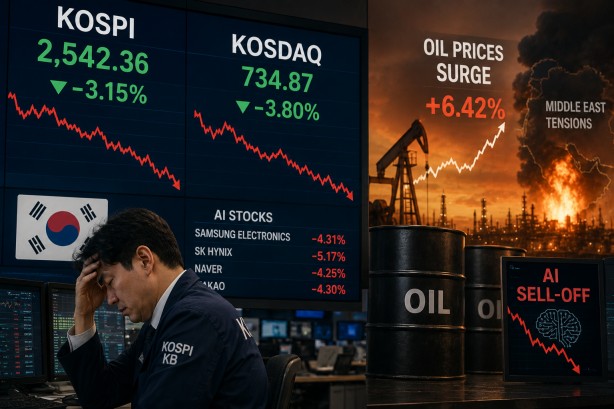
Asian stock markets mostly experienced gains on Monday, although South Korea’s Kospi index saw a significant drop of nearly 5%. This decline came as investors offloaded shares in artificial intelligence-related companies due to increasing concerns about the valuations in the sector. In contrast, oil prices rose sharply amid escalating tensions between the United States and Iran, with Brent crude climbing 2.6% to $90.40 per barrel and U.S. crude advancing 2.2% to $83.58 per barrel. The apprehension over possible disruptions in the Middle East added to the pressure on global oil supplies, particularly as tanker traffic through the critical Strait of Hormuz slowed markedly.
Leading the losses in South Korea were major technology firms, with Samsung Electronics tumbling 4.4% and chipmaker SK Hynix dipping 3.3%. While the Kospi index suffered, other markets in the region showed steadier performances. Taiwan’s stock market remained relatively stable, buoyed by a 2% increase in Taiwan Semiconductor Manufacturing Co. Meanwhile, Hong Kong’s Hang Seng index appreciated by 2.1%, and China’s Shanghai Composite rose by 1.2%. Australia’s main index also posted modest gains, though India’s Sensex declined by 0.9%.
The global technology sector is currently under scrutiny, as investors reassess the massive investments in artificial intelligence and consider whether a speculative bubble has formed. This sentiment was further influenced by the introduction of Kimi K3, a new open-source AI model created by Beijing-based Moonshot AI, which has intensified competition in the swiftly advancing field.
In the United States, Wall Street concluded the previous week on a downbeat note, with major indices such as the S&P 500, Dow Jones Industrial Average, and Nasdaq all recording losses. Chip stocks were particularly hard hit, with notable declines in Nvidia, Broadcom, and AMD. The broader market’s performance reflects ongoing investor caution amid the fluctuating dynamics of the technology sector.