
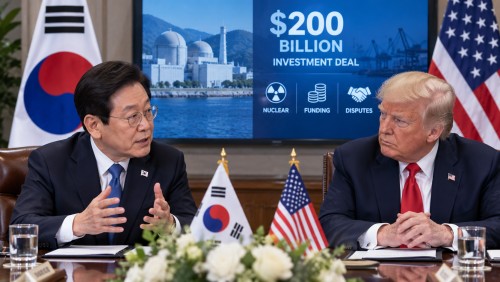
Negotiations between South Korea and the United States over a substantial $200 billion investment commitment have encountered significant hurdles, particularly surrounding nuclear projects and financial terms. These ongoing discussions have seen major disagreements on nuclear reactor design selection and the timing of South Korea’s financial contributions, according to the South Korean Industry Ministry.
The primary sticking point in the talks is the construction of eight nuclear reactors in the United States. The plan includes six reactors using Westinghouse’s AP1000 design and two employing South Korea’s APR1400 technology. However, U.S. officials and Westinghouse have expressed opposition to incorporating the Korean-designed APR1400, complicating the finalization of the nuclear component. South Korea has earmarked approximately $120 billion of its total investment for nuclear-related projects.
Another contentious issue is South Korea’s desired stake in Westinghouse. Seoul is pushing for a 15% to 20% ownership share, complete with voting rights and a board seat, while Westinghouse aims to cap South Korea’s ownership at below 10%. Additionally, South Korea is considering involvement in a U.S. project for processing spent nuclear fuel and a proposed liquefied natural gas project in Alaska, though concerns about costs and returns linger.
Financial terms and funding schedules have further added to the complexity of the negotiations. The United States has reportedly requested over $9 billion from South Korea by the end of the year. In contrast, South Korea initially planned to contribute a smaller amount in 2026 and increase investments thereafter. Disagreements also persist on how to calculate investment returns and losses, with South Korea advocating for a model where profits from successful projects offset losses from less successful ones, while the U.S. prefers a separate accounting approach for each project.
Despite these challenges, both nations remain engaged in discussions to iron out the details of this ambitious investment package. The South Korean Industry Ministry has emphasized that the final projects, funding structure, and investment arrangements are still under negotiation, with no definitive agreements reached yet.